Introduction
Gum Arabic (also known as Acacia gum or Gum arabica in some contexts) is a natural exudate harvested primarily from Acacia senegal (variety kerensis in Kenya) and, to a lesser extent, Acacia seyal. In Kenya, this hardy, nitrogen-fixing leguminous tree is native to the arid and semi-arid lands (ASALs), which cover ~80% of the country. It thrives in the drylands of northern and eastern Kenya (e.g., Garissa, Isiolo, Mandera, Marsabit, Samburu, Turkana, Wajir), where it supports ecosystem restoration, soil fertility, and livelihoods for pastoralist communities. Kenya's production remains under-exploited (typically 300-400 metric tonnes exported annually in recent historical data), yet global demand for this clean-label hydrocolloid is rising steadily.
This comprehensive guide synthesizes botanical, agronomic, economic, and market data tailored to Kenyan conditions, drawing on Green Angels' field research, local projects, and global trends.
Growth Cycle and Harvest Timeline
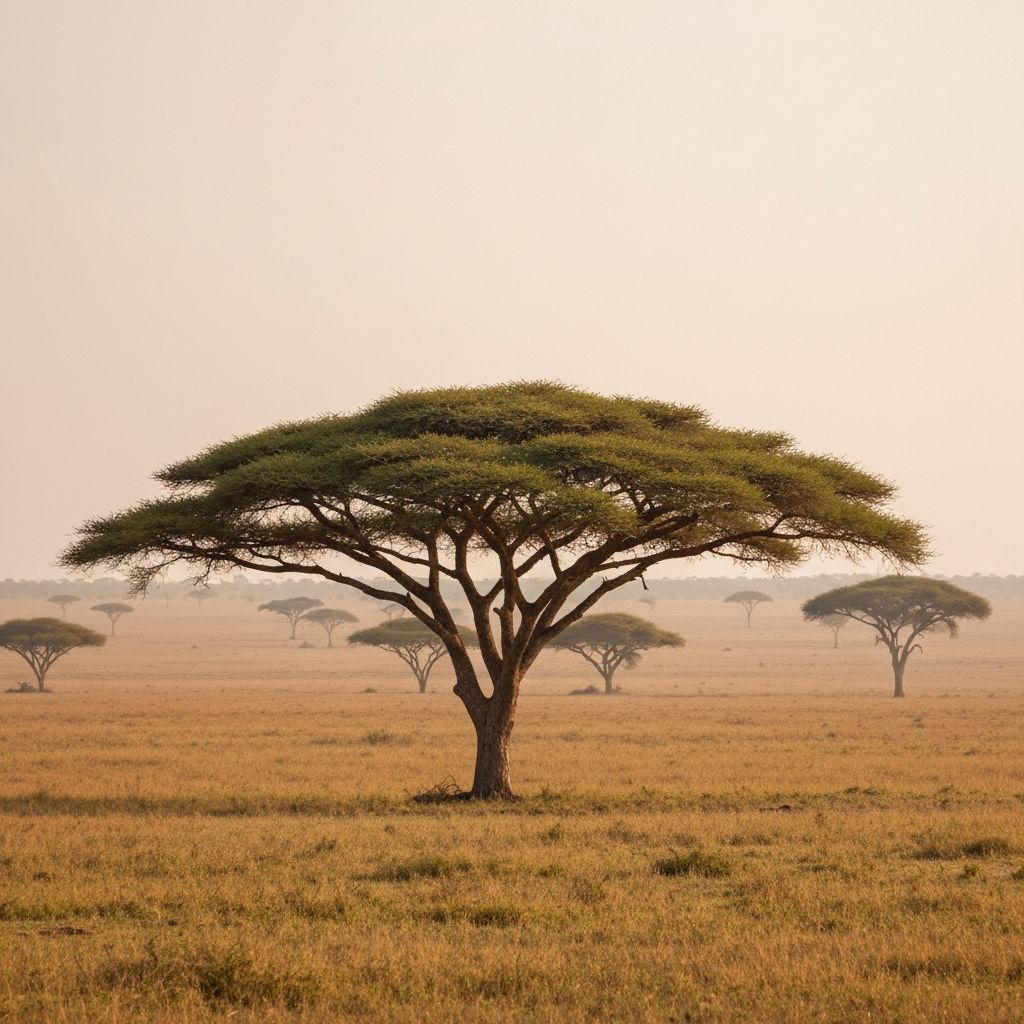
Acacia senegal is extremely drought-tolerant, requiring 100-800 mm annual rainfall (optimal 280-450 mm) and tolerating 8-11 months of dry periods. It grows on sandy to slightly loamy soils (pH 5-8) and is sensitive to waterlogging and frost. Trees reach 2-6 m (occasionally taller) with an umbrella-shaped crown and thorny branches.
Planting to First Harvest
- Gum Arabic can appear as early as 2 years after direct seeding or transplanting in the field
- Consistent commercial harvest: Quality and yield stabilize at 5 years
- Peak production between 7-15 years
- Trees remain productive up to ~20 years before yields decline
Traditional Gum Garden System
Modeled on Sudan's 20-25-year bush-fallow rotations, young trees (0-5 years) can be intercropped with cereals. Small harvests begin at 6-11 years, abundant yields at 12-17 years, and gradual decline thereafter. Regeneration occurs readily via coppicing (cutting to ground level stimulates new shoots). Young plants need protection from livestock for the first 3-5 years.
Harvesting Gum Arabic
Harvesting occurs exclusively in the dry season (typically June-September and January-March in Kenya), when trees naturally shed leaves. Exudation can be natural (bark cracks in harsh conditions) or induced by tapping.
Step-by-Step Kenyan Harvesting Process
-
Tapping: Use a sharp tool (traditional axe, modern "Sonki" spear-like blade) to make shallow incisions (~60 cm long × 5 cm wide) on the trunk or branches. Avoid deep cuts that damage the cambium.
-
Exudation and drying: Sap oozes as tears/nodules. It solidifies in 4-5 days (or up to 5 weeks for first collection in some systems), forming rough, amber-to-clear spheres.
-
Collection: Pick nodules manually in the morning (before daytime heat melts them). Repeat collections every ~15 days from the same wounds.
-
Post-harvest: Clean, sort, and grade by color/size/quality on-site or at depots. Higher grades fetch better prices.
Yield Notes: Wild trees yield less reliably than cultivated "gum gardens." Annual yield per mature tree: 100-300 g (up to 800 g-1 kg in optimal conditions). Plantation yields: ~200 kg/ha at 5 × 5 m spacing.
Labor: Harvesting is accessible to women and youth; it requires minimal equipment (gloves recommended due to thorns) but is physically demanding in thorny terrain.
Tree Maintenance and Care
Young Trees (0-3/5 years)
- Weed 2-3 times in the first two growing seasons
- Protect from grazing (fencing or community bylaws)
- Allow coppicing for regeneration
Mature Stands
- Minimal irrigation needed
- Occasional coppicing for regeneration
- Control invasive species (e.g., Prosopis juliflora)
- Ecosystem integration in agroforestry systems
Pest/Disease Management: Generally resilient; monitor for minor bark damage from poor tapping. No chemical inputs required—ideal for organic certification and regenerative agroforestry. Plant in agroforestry systems or around water pans for soil stabilization and nitrogen fixation. Community-managed groves follow traditional rules (e.g., no cutting live trees).
Economics and Profitability
Low Establishment Costs
- Seeds/seedlings: Get certified seedlings from Green Angels nurseries
- Direct sowing or basic nursery
- Initial maintenance: ~KSh 5,000 to 10,000/ha
- Negligible ongoing costs
Pricing and Returns
- Collector/farmgate: ~KSh 39/kg (mid-2010s data)
- Bonus via revolving funds: +KSh 10/kg
- Graded/sorted: Premium prices
- Retail/processed: KSh 175 to 483/kg domestically
- Export FOB: ~USD 6.84/kg (2024)
Profitability Analysis Highly attractive as a dry-season safety net. A single household with access to 50-100 trees can generate meaningful supplemental income (hundreds to thousands of KSh per season) with near-zero capital outlay. Projects report women using proceeds for school fees, livestock restocking, water tanks, and healthcare. At plantation scale, 200 kg/ha at modest farmgate prices yields strong returns versus traditional pastoralism. Value addition (cleaning/grading/processing) multiplies margins. Overall ROI is excellent due to minimal inputs and complementary timing with livestock herding.
Market Demand and Trends
Global demand for Gum Arabic is robust and growing, driven by clean-label preferences in food, pharma, and cosmetics. Historical crude exports tripled from ~35,000 tonnes (1992-94) to ~102,000 tonnes (2014-16). Current market size estimates range USD 515-1,100 million (2025-26), projected to reach USD 760-2,200 million by 2030-35 at 6-8% CAGR.
Key Market Statistics:
- Current Market Size: USD 515M to 1.1B
- Projected by 2030-35: USD 760M to 2.2B
- Annual Growth Rate: 6 to 8%
Key drivers: natural stabilizers in beverages, confectionery, and pharmaceuticals; no perfect synthetic substitute exists. Kenya's contribution is small but growing via organized collection (e.g., Acacia EPZ linking ~6,000 households). Demand far exceeds local supply; Kenya could scale significantly in ASAL counties. Trends show steady upward trajectory despite Sudan's supply volatility (conflict/climate). Long-term outlook is positive, with Europe and North America as major importers. Kenya's untapped wild and planted resources position it for export expansion.
Common Uses
Food & Beverages (Largest Share)
Emulsifier/stabilizer in soft drinks, confectionery, jams, bakery, dairy (prevents separation, extends shelf life).
Pharmaceuticals & Supplements
Binder in tablets, encapsulant for flavors/nutrients.
Personal Care & Cosmetics
Thickener in lotions, toothpaste.
Industrial Applications
Adhesives, inks, paints, lithography.
Traditional/Local Uses
Chewed casually or used medicinally in Kenyan drylands.
Common Buyers in Kenya
Primary Buyers Local brokers → processors/exporters such as Acacia EPZ (Nairobi), which cleans, grades, and exports to Europe (long-term contracts with major buyers). Other value-adders include firms linked to Davison Polymers or gum/resin programs.
International Buyers European food/pharma giants (via Kenyan processors); global traders.
Emerging Channels Direct community sales to certified exporters under projects (e.g., Self Help Africa, Palladium Group/MRTA-supported initiatives) bypass middlemen for better prices.
Success Stories from Kenya
Samburu Women Collectors
Thousands of women empowered via Acacia EPZ networks. Examples include Caroline Lekuiye (trained collectors, built water tank/storeroom) and Raima (uses income for family needs). Women have restocked goats post-drought and paid school fees.
Acacia EPZ & AgriFI/Self Help Africa Projects
Linked ~6,000 households; introduced revolving funds (KSh 10/kg bonus) for micro-loans. Demonstrated landscape restoration + income in Isiolo/Samburu.
Community Gum Gardens
Pastoralists in ASAL counties report reliable dry-season cash where wild harvesting was sporadic. Green Angels-supported planting shows scalable potential for youth/women groups.
Challenges and Disadvantages
Labor & Safety
Thorny trees; physically demanding; risk of injury.
Seasonality & Climate
Limited to dry periods; prolonged droughts/climate change stress trees and reduce yields.
Market Access
Informal chains → low farmgate prices; middlemen capture margins; insecurity in some ASAL areas limits collection.
Environmental Factors
Over-logging for firewood; invasive species displacement; quality variability if tapping/storage is poor.
Scale-up Barriers
Cashflow/liquidity for collectors; limited processing infrastructure; transport costs in remote areas.
Global Risks
Synthetic substitutes (xanthan/guar) in some applications; supply volatility elsewhere affects prices.
Conclusion and Recommendations
Gum Arabic offers a resilient, low-input, high-potential enterprise for Kenya's drylands—ecologically restorative and economically empowering, especially for women and pastoralists. With organized collection, community revolving funds, and value addition, profitability can rise sharply.
Key Recommendations
- Invest in Green Angels seedlings and training on best tapping/grading practices
- Develop direct exporter linkages to bypass middlemen
- Scale cultivated gum gardens to transform ASAL economies
- Support community-managed initiatives for sustainable production
For implementation support, contact Green Angels or active projects like Acacia EPZ. This crop truly exemplifies sustainable botany in action.
Related Topics
Related Articles
Best Economical and Productive Trees to Grow in Embu's Semi-Arid Zones
Embu County spans both the productive highlands and the harsh ASAL zones of Mbeere. Discover which trees survive the heat, thrive in sandy soils, and pay back quickly — mango, moringa, pawpaw, Mukau, and tamarind.
Read More
How to Grow a High-Yield Backyard Fruit Orchard in Nairobi: A Beginner's Guide
You don't need a farm to grow your own fruit. Discover how to turn unused compound space into a productive backyard orchard with grafted seedlings suited to Nairobi's soils and seasons.
Read More
How to Successfully Grow Grafted Hass Avocado and Pixie Oranges in Nairobi's Climate
A practical guide for Nairobi farmers on growing high-value grafted fruit trees. Learn about microclimates, soil preparation, pest management, and the economics of Hass avocado and Pixie orange orchards near the capital.
Read More